Why Your Service Business Can't Scale (And the 5 Systems You're Missing)
You're working 60+ hours a week. Revenue is up. But you're still the bottleneck.
Every time you try to grow your service business: whether you run an HVAC company, plumbing operation, landscaping crew, or electrical contracting firm: the same thing happens: More clients mean more chaos. More hours. More problems you have to personally solve.
Here's the brutal truth: Your service business can't scale because you're selling your time instead of building systems.
You've probably heard this before. But let me show you exactly which systems you're missing: and how to build them without spending the next decade figuring it out on your own.
The Real Problem With Scaling Service Businesses
Most service business owners think they need more leads. More trucks. More technicians.
Wrong.
What you actually need is to stop being the linchpin that holds everything together. Because right now? You're the lead salesperson. The quality control manager. The customer service department. The trainer. The strategist.
And that's precisely why you can't scale.
When your business model requires you to personally touch every job, approve every estimate, and handle every upset customer: you don't have a business. You have an expensive job you can't quit.
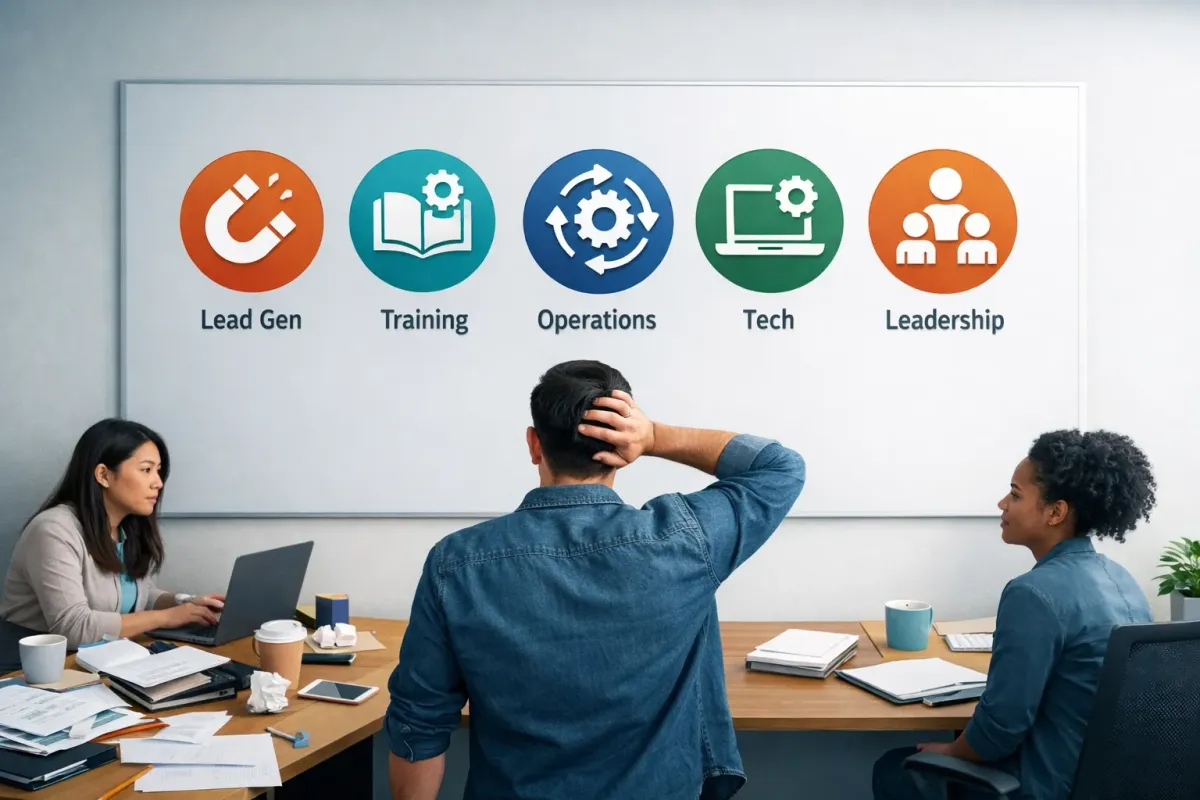
The businesses that successfully scale from $500K to $2M to $5M and beyond? They've built five core systems that run without them. Let's break down what you're missing.

System #1: The Lead Generation System (That Doesn't Require You)
Right now, you're probably getting most of your business one of three ways:
Referrals from happy customers
You personally networking and building relationships
Random calls from people who found you online
That's not a lead generation system. That's hope with a phone number.
Here's what a real lead generation system looks like:
A predictable, consistent flow of qualified prospects that comes in whether you work 60 hours this week or take a two-week vacation. This means having multiple channels working simultaneously: a website that actually converts visitors, a referral program with built-in incentives, strategic partnerships that send you pre-qualified leads, and yes, some paid advertising that's actually tracked and measured (NOT “boost a post and pray” ❌).
The golden nugget? 💡 Document your three best customer sources from last year, then build one systematic process around each. If 40% of your revenue came from contractor referrals, create a formal referral program with quarterly check-ins, co-marketing opportunities, and incentives. Make it systematic, not accidental.
Here’s how to weave paid ads into that same systematic, non-accidental approach:
🎯 Google Ads = high intent, “I need help now” leads. When someone searches “emergency plumber near me” or “AC repair tonight,” they’re raising their hand. Your system should route those leads to a fast booking path (call tracking, dedicated landing page, and a same-day follow-up standard) so you win the job without you personally jumping in.
📍 Facebook Ads = local awareness + neighborhood targeting. Facebook isn’t about intent as much as it’s about staying visible in the exact areas you want more work (specific zip codes, neighborhoods, radius targeting around your best streets, new developments, etc.). Your system should run consistent “proof + trust” creative (reviews, before/after, quick tips) so when the “need” hits later… you’re the first company they remember.
✅ The point isn’t “run ads.” The point is build a lead machine: clear offer → tracked channel → documented follow-up → weekly review → monthly optimization.
Most service business owners wait until they're desperate for work to start prospecting. Then they get busy, stop marketing, and the cycle repeats. That's not scaling: that's surviving.
System #2: The Training & Onboarding System (That Actually Works)
You've hired technicians who "should know this stuff already." Then you're frustrated when they don't represent your brand, cut corners, or upset customers.
Let's be honest: That's a you problem, not a them problem.
Your competition for quality technicians is fierce. The people you can afford to hire often have skill gaps: both technical and soft skills. If you don't have a structured training system, you're gambling that each new hire will magically figure out your standards through osmosis.
Here's what you need:
A documented onboarding process that takes a new hire from day one to fully productive in 90 days or less. This includes technical training on your specific methods, customer service expectations with actual scripts and role-playing, shadowing programs with clear milestones, and ongoing skill development.
The businesses that scale? They treat training as an investment, not an expense. They know that a technician who's been properly trained will generate 3-5x their cost in additional revenue through upsells, customer satisfaction, and reduced errors.
Your move: Create a simple 90-day onboarding checklist this week. Include technical certifications needed, customer interaction standards, company processes they must learn, and who's responsible for training each element. That's your starting point.
System #3: The Operations System (Your Playbook for Everything)
Quick test: If you disappeared for 30 days, could your team handle a complex customer issue without calling you?
If you hesitated even for a second, you don't have an operations system.

Every service business that scales has created playbooks for how things get done. How you handle estimates. How you manage job scheduling. How you deal with customer complaints. How you order materials. How you handle warranty issues.
This isn't about micromanaging: it's about creating consistency that allows you to hire B-players who can deliver A+ results by following your process.
The most successful service businesses I coach have documented:
Standard operating procedures for common jobs
Quality control checklists for every service type
Communication templates for customer touchpoints
Clear escalation paths for problems
Decision-making frameworks for field staff
Does this take time to create? Absolutely. But here's the reality: You're already doing these things: you're just doing them from memory, inconsistently, and only when you're personally involved.
💰 Golden nugget time: Record yourself or your best technician completing your three most common jobs. Have someone transcribe those recordings into step-by-step checklists. That's 80% of your operations manual done in a week.
System #4: The Technology System (Stop Working Like It's 1995)
I see service business owners still managing schedules with paper calendars, tracking inventory in Excel, and communicating with customers through text messages they'll never be able to find again.
Then they wonder why they can't scale.
Technology isn't optional anymore. The right tools allow you to:
Schedule jobs efficiently without playing phone tag
Track technician productivity and job profitability in real-time
Send automated customer communications that build trust
Monitor quality without being on every job site
Make data-driven decisions instead of guessing
You don't need to become a tech company. But you do need field service management software, a CRM that actually gets used, digital payment processing, and automated customer communication tools.
The businesses crushing it in trades and services? They're using technology to create leverage. Their technicians use tablets to show customers diagnostic data, pull up customer history instantly, and process payments on-site. They're not working harder: they're working smarter.
Start here: Implement one piece of technology this quarter that eliminates your biggest daily frustration. If it's scheduling chaos, get real scheduling software. If it's chasing payments, set up automated billing. Pick one, implement it fully, then move to the next.
System #5: The Leadership System (Building a Team That Doesn't Need You)
Here's the hard truth: The team that got you to $1M can't get you to $3M.
As you scale, you need people who can think strategically, make decisions independently, and lead other people. You need managers, not just technicians. You need someone who can run operations while you work on the business instead of in it.
Most service business owners promote their best technician to manager: then wonder why everything falls apart. Being great at HVAC installation doesn't mean you can manage people, handle scheduling conflicts, or drive profitability.

A leadership system includes:
Clear organizational structure with defined roles
Key performance indicators for every position
Regular one-on-one meetings with accountability
Leadership development for high-performers
Succession planning for critical roles
The goal? Cut your working hours in half while scaling revenue. That only happens when you have leaders who can run departments, make decisions, and solve problems without you.
Your golden nugget: 🎯 Identify the three decisions you make most often in a week. Document your decision-making criteria for each. Train someone else to make those decisions. Review their decisions weekly, then monthly, then quarterly. That's how you build leaders.
The Scaling Roadmap: What to Do Next
You now know the five systems keeping you trapped:
✅ Lead Generation System
✅ Training & Onboarding System
✅ Operations System
✅ Technology System
✅ Leadership System
But knowing isn't the same as doing.
Most service business owners try to build all of this simultaneously, get overwhelmed, and quit. Then they're back to working 60-hour weeks, personally handling everything, and wondering why their business owns them instead of the other way around.
Here's the truth: Building these systems takes focus, accountability, and someone who's done it before to guide you through the process.
That's exactly what we do at Todd Masters FocalPoint Coaching. We help service business owners build these five systems: in the right order, with the right tools, without wasting years and hundreds of thousands in trial and error.
Your Business Should Work For You: Not The Other Way Around
You didn't start your service business to work yourself into an early grave. You started it for freedom, for income, for control.
But somewhere along the way, the business started controlling you.
The good news? It doesn't have to be this way.
Service businesses CAN scale. You CAN cut your hours while growing revenue. You CAN build a company that runs profitably without your constant involvement.
But only if you stop selling your time and start building systems.
🔥 Ready to build a business that doesn't need you to babysit it every day? Let's talk. Book a free strategy session and we'll diagnose exactly which system is your biggest bottleneck: and create a 90-day plan to fix it.
Because the alternative is another year of 60-hour weeks, growth that creates more stress instead of more freedom, and wondering if you'll ever actually own a business instead of just an expensive job.
Your move. 📅