When to Pause and Reset: How Strong Leaders Recalibrate Without Quitting
When to Pause and Reset: How Strong Leaders Recalibrate Without Quitting
by The Point Success Guide in Leadership Posted on
14/01/2026 11:09
SHARE THIS ARTICLE
Most leadership stalls don’t happen because people give up. They happen because leaders keep going when the conditions have shifted.
What worked a few months ago no longer fits. The assumptions have changed. The environment has moved. But the plan stays in motion because stopping feels risky and adjusting feels like backtracking.
So executives push. They add urgency. They tighten oversight. They try to outwork the friction. And slowly, effort starts producing less return.
This is the moment that requires judgment, not grit.
Strong leaders know the difference between resistance that needs to be worked through and misalignment that needs to be corrected. Recalibrating isn’t quitting. It’s responding accurately to the reality in front of you.
Many leaders hesitate here because they associate momentum with consistency. If you change direction, it must mean the original plan was wrong. If you pause, it must mean progress has stopped. In practice, the opposite is often true. Momentum breaks when those in charge keep executing against conditions that no longer exist.
The ability to reset without abandoning the goal is one of the most underdeveloped leadership skills. It requires reflection without self-criticism and adjustment without defensiveness. And it requires doing it before confidence, trust, or energy erodes further.
The most effective resets don’t come from dramatic overhauls. They come from deliberate pauses that create space to assess what has changed and what now matters most.
A useful place to start is separating effort from accuracy. Ask yourself: If I were designing this plan today, with what I know now, what would I keep the same and what would I change? If the answer is “most of it,” you likely need to push through. If the answer is “key assumptions,” you likely need to recalibrate.
Another signal is friction that doesn’t resolve with focus. Every meaningful initiative has resistance, but when the same obstacles keep appearing in different forms, it’s often a sign that the system, not the people, is misaligned. Pushing harder in those moments rarely creates momentum. It usually creates fatigue.
A simple way to test this is to look at decision energy.
Are decisions getting harder to land even with capable people involved?
Are conversations circling without resolution?
That’s often an indicator that priorities or constraints need to be revisited, not reinforced.
Recalibration works best when it turns reflection into movement. One effective approach is a short reset review built around three prompts:
What assumptions were true when we started that may no longer be true?
What constraints have changed that affect how we execute?
What decision would unlock forward movement right now?
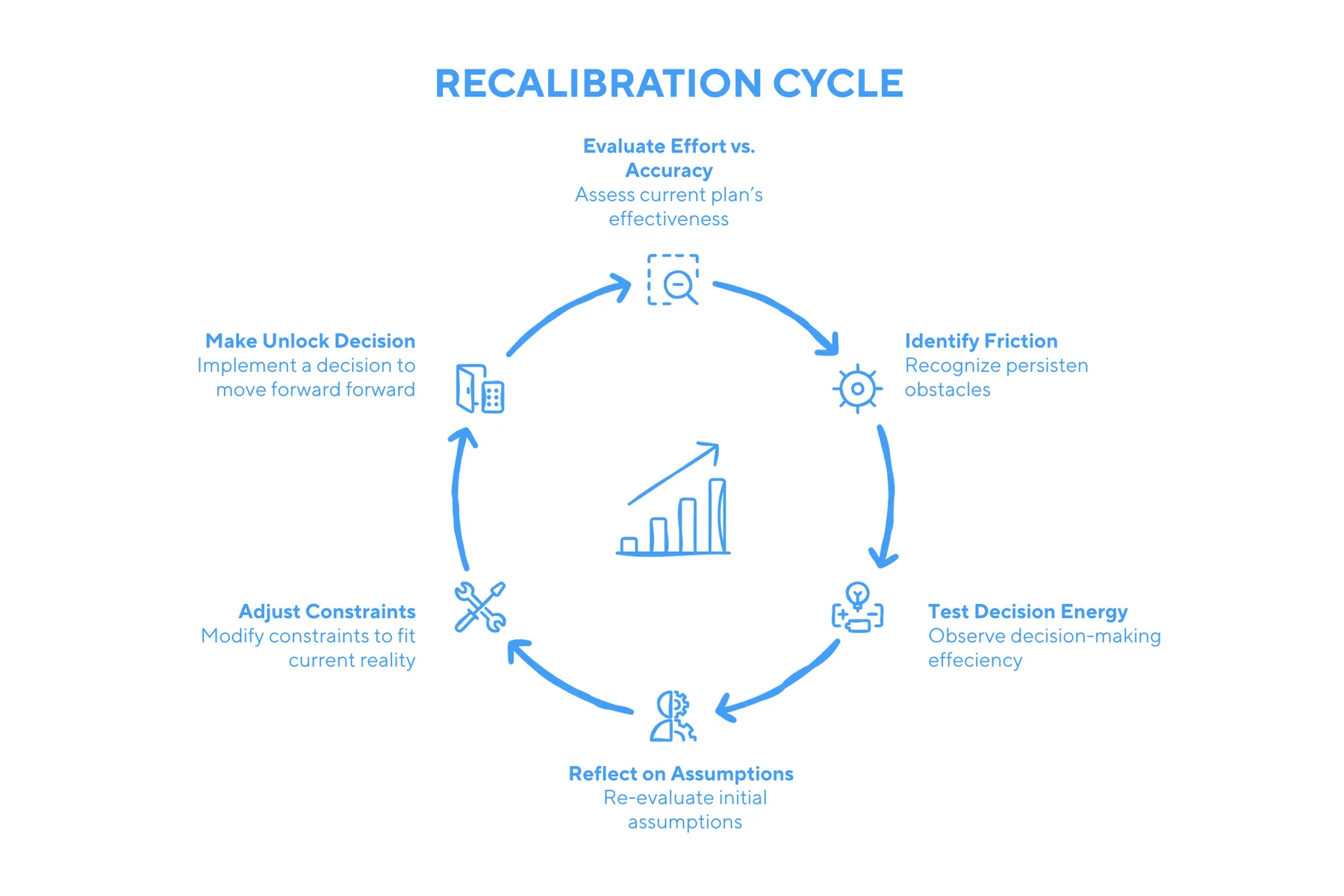
This isn’t about rehashing the past or assigning blame. It’s about updating your map before continuing the journey.
Leaders often get stuck here because they fear what a pause signals to their team. But teams usually feel relief, not doubt, when leaders name reality clearly. Confidence comes from alignment, not from pretending nothing has changed.
The correction most leaders need is not more pressure. It’s permission to adjust. When leaders model thoughtful recalibration, they give their teams clarity about what matters now and what can wait. That restores trust and focus far faster than pushing through uncertainty.
This is also where coaching plays a quiet but important role. These moments are hard to navigate alone because leaders are inside the pressure they’re trying to evaluate. Coaching creates space to step back, test assumptions, and distinguish between discomfort that builds strength and friction that signals misdirection. It’s the kind of conversation designed for moments when the next move matters more than the last one.
Before the week ends, consider this:
What are you pushing through right now that might benefit from a reset?
What assumption are you still operating under that deserves to be questioned?
And what one adjustment would make the next phase more effective, not just faster?
Pausing with intention is not losing momentum. It’s how strong leaders make sure the momentum is pointed in the right direction.
------------------------------
Sources:
https://hbr.org/2025/10/how-to-lead-when-the-conditions-for-success-suddenly-disappear
https://www.strategy-business.com/blog/Four-questions-for-a-rapid-leadership-reset